|
|
|
|
|
|
|
The Blind Spots in Modern Epidemiology |
|
|
Author: Bruce Lanphear, MD, MPH NOTE: This article was originally published on June 16, 2026 by Plagues, Pollution & Poverty on Substack. “It’s criminal not to solve tuberculosis.” — Bill Gates Why do some preventable deaths spark a global response while others barely register? It is a question that has bothered me for years. When tuberculosis kills a child in Africa, governments mobilize. Foundations invest billions. Scientists race to develop better diagnostics, drugs, and vaccines. When malaria surges, public health agencies track every case. When HIV emerged, the world eventually launched one of the largest public health campaigns in history. But when lead poisoning contributes to millions of deaths, when air pollution shortens lives in every city on Earth, or when toxic chemicals increase the risk of cancer, heart disease, and developmental disorders, the response is strikingly different. Why? The answer may lie in a distinction that epidemiologist Elizabeth Barrett-Connor challenged nearly fifty years ago.
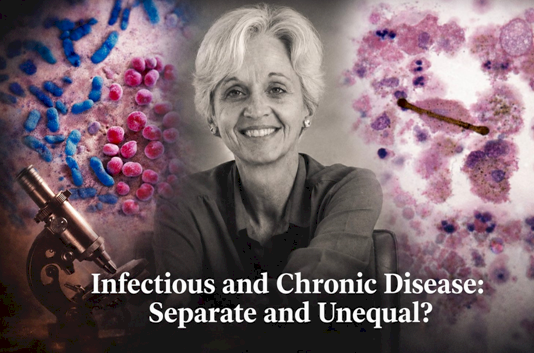
In 1979, Barrett-Connor published an essay with the provocative title Infectious and Chronic Disease Epidemiology: Separate and Unequal? She argued that the divide between infectious and chronic disease was largely artificial. Infectious diseases were assumed to be acute and caused by germs. Chronic diseases were assumed to develop slowly and arise from lifestyle, aging, or unknown causes. But Barrett-Connor pointed out that many infectious diseases were chronic, many chronic diseases might someday prove to be infectious, and all diseases involved interactions between biology, environment, and behavior. The separation, she argued, was not only arbitrary—it was holding epidemiology back. History has been kind to her argument. Since Barrett-Connor wrote those words, researchers have discovered that many diseases once considered purely chronic are caused, at least in part, by pathogens. Human papillomavirus causes most cervical cancers. Hepatitis B and C infections cause many liver cancers. Helicobacter pylori causes stomach ulcers and stomach cancer. Epstein-Barr virus is linked to several cancers and is now considered a major contributor to multiple sclerosis. In one sense, Barrett-Connor won. The wall between infectious and chronic disease has largely collapsed. Today, few physicians would argue that cervical cancer is simply a chronic disease. We recognize it as a preventable consequence of infection. We vaccinate children against HPV. We screen for hepatitis. We treat infections before they lead to cancer. The discovery of a microbial cause transformed how we think about prevention. Yet something curious happened along the way. We accepted Barrett-Connor’s argument when the culprit was a pathogen. We have been far less willing to accept it when the culprit is a toxic chemical or pollutant. Consider the language we use. Bill Gates argued that “it’s criminal not to solve TB” and extended the same reasoning to HIV and malaria. Few people would disagree. Tuberculosis kills more than a million people each year. It is preventable. It is treatable. To ignore it would be morally indefensible. But what about lead poisoning? Lead exposure kills between 3.5 and 5.5 million deaths annually, primarily through cardiovascular disease. Air pollution contributes millions more. Add in occupational exposures, contaminated water, pesticides, asbestos, and other toxic pollutants, and the toll becomes staggering. The Lancet Commission on Pollution and Health estimated that pollution contributes to roughly nine million deaths each year worldwide. If newer estimates of lead-related mortality are accurate, the total burden from toxic chemicals and pollutants approach one in five deaths globally. One in five. Pause for a moment and imagine a new infectious disease that killed one in five people. There would be emergency declarations. Daily news coverage. International summits. Massive investments in research. Politicians would compete to be seen taking action. Instead, these deaths occur quietly. A heart attack here. A stroke there. A diagnosis of lung cancer. A child struggling in school because of lead exposure. A premature birth linked to air pollution. No epidemic curve appears on television screens. No nightly death count scrolls across the bottom of the news. The victims are scattered. The causes are invisible. The outrage dissipates. And so we have created two different categories of preventable death. When a child dies from malaria, we ask how to prevent the next death. When a child loses IQ points from lead exposure, we ask how to help them cope. When tuberculosis spreads, we search for the source. When pollution spreads, we often debate whether the evidence is sufficient to justify action. This distinction would have puzzled Barrett-Connor. Her central insight was that epidemiology should focus on causes rather than labels. A disease caused by a bacterium and a disease caused by a toxic chemical are both environmental diseases. Both arise from conditions outside the body. Both can be studied. Both can be prevented. The difference is not scientific. It is political. Tuberculosis has no lobbyists. Malaria does not fund public relations campaigns. Viruses do not hire lawyers to challenge regulations. Lead, asbestos, PFAS, pesticides, tobacco, and fossil fuels do. For decades, industries associated with these hazards have questioned the evidence, emphasized uncertainty, delayed regulation, and shifted responsibility onto individuals. The result is not merely confusion. It is a profound distortion of our moral priorities. We have come to regard infectious diseases as preventable and chronic diseases as inevitable. Yet many of the leading chronic diseases are no more inevitable than tuberculosis. The decline in childhood lead poisoning demonstrates this. Removing lead from gasoline reduced deaths from heart attacks. Air pollution regulations have extended life expectancy. Smoking restrictions have prevented millions of premature deaths. These are among the greatest public health successes of the last century. But we rarely describe them that way. We celebrate vaccines. We celebrate antibiotics. We celebrate the eradication of smallpox. We are less likely to celebrate the elimination of lead from gasoline, even though it has prevented millions of deaths and improved the lives of hundreds of millions of children. Perhaps that is because one victory fits comfortably within our traditional understanding of disease while the other challenges it. The irony is that Barrett-Connor saw this coming. She argued that epidemiologists should stop dividing themselves into camps and simply call themselves epidemiologists. Acute diseases and chronic diseases, she wrote, are not separate species. Neither are the scientists who study them. Nearly fifty years later, we may need to take her argument one step further. The challenge is no longer to erase the boundary between infectious and chronic disease. The challenge is to erase the boundary between the preventable deaths we take seriously and the preventable deaths we have learned to tolerate. Bill Gates is right. It is criminal not to solve tuberculosis. But if millions of deaths from toxic chemicals and pollutants are also preventable, the more uncomfortable question is this: Why don’t we treat those deaths the same way? ■
To read more content like this please subscribe to Plagues, Pollution & Poverty on Substack.
|
|
|
|
|