|
|
|
|
|
|
|
What if Fluoride Was Never Safe? |
|
|
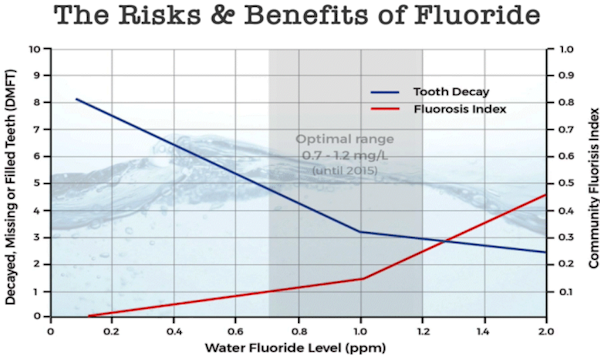
Author: Bruce Lanphear, MD, MPH NOTE: This article was originally published on October 28, 2025 by Plagues, Pollution & Poverty on Substack. A Public Health Triumph—or a Cautionary Tale?For decades, the story of fluoridation has been told as a triumph of modern science—a simple, inexpensive way to prevent tooth decay. In 1999, the U.S. Centers for Disease Control and Prevention listed community water fluoridation among the “Ten Great Public Health Achievements of the 20th Century.” But every triumph deserves re-examination. Behind the tidy narrative lies a more complicated story—one that involves corporate influence, incomplete data, and an assumption of safety that may have blinded us to risk.The Birth of a Chemical CureThe practice began with H. Trendley Dean, a dentist with the U.S. Public Health Service. In the 1930s and 40s, Dean examined more than 7,000 children in 21 towns across the American West, where natural fluoride levels in drinking water varied widely. He discovered that levels up to one part per million of fluoride reduced tooth decay, while higher levels produced mottled or stained enamel—a condition he called dental fluorosis. It looked like a manageable trade-off: fewer cavities in exchange for a few white spots. And in mid-century America, when tooth decay was rampant, that sounded like progress.
Dean’s findings were published in 1942, and soon fluoride was hailed as a modern miracle. Yet even at the time, there were doubts. In 1944, the editor of the Journal of the American Dental Association, Dr. Pierce Anthony, called fluoridation “speculatively attractive” but warned that the addition of a highly toxic substance to drinking water” carried potential dangers that had not been studied. The following year, in 1945, the U.S. Public Health Service launched the first community trials—in Grand Rapids, Michigan (with Muskegon as a control), and in Newburgh, New York (with Kingston as its control). Dr. David Ast, the chief of the New York State Health Department Dental Bureau, assured the public that “special attention will be given to mental development and emotional stability” of exposed children. No such data were ever published; perhaps they were never collected. But they indicate that concerns about the potential impact of fluoride on brain development were recognized. How a Public Experiment Became PolicyBy the early 1950s, fluoridation was spreading rapidly. Following on the heels of DuPont’s massive marketing campaign, the postwar era was infatuated with chemistry as progress—“better living through chemistry”. The American Dental Association and the U.S. Public Health Service became its most enthusiastic promoters. Tooth decay was a visible public problem; fluoridation offered an elegant, invisible solution. By 1960, over 50 million Americans were drinking fluoridated water. But the toxicity of fluoride was defined narrowly—as dental fluorosis, not systemic harm. Few questioned whether a substance that could alter enamel formation might also affect other tissues. And no one—despite the assurance of Dr. David Ast—had tested for subtle developmental neurotoxicity. By 1971, the National Institute for Dental Research launched a national caries-prevention program with fluoridation as its centerpiece. Decay rates did fall—but they also fell in unfluoridated countries such as Sweden, Denmark, and the Netherlands, where improvements in diet, hygiene, and dental care occurred at the same time. That should have prompted a deeper look. It didn’t. Regulatory InertiaUnder the 1974 Safe Drinking Water Act, the U.S. Environmental Protection Agency was required to set standards for contaminants that may pose health risks. In 1986, the EPA set a maximum contaminant level of 4 mg/L for fluoride—a threshold intended to prevent severe dental fluorosis and skeletal fluorosis. Two decades later, in 2006, the National Research Council reviewed the evidence and concluded that this standard was too high and failed to protect against bone fractures and other adverse effects. The committee also found “several lines of evidence” suggesting that fluoride may affect the brain, thyroid, and endocrine system. They recommended the EPA to lower its standard for the levels of fluoride in drinking water. Nearly twenty years later, the agency has not acted. Rising Fluorosis, Hidden ConcernsBy 2010, rates of dental fluorosis in U.S. children had climbed dramatically. One CDC survey found that over 60 percent of adolescents had some degree of fluorosis—visible evidence of overexposure. In 2015, the U.S. Public Health Service lowered its recommended level for community water systems from 0.7–1.2 ppm to a single value of 0.7 ppm. The official reason was aesthetic: to reduce mottled teeth. Revisiting the Science We Thought We KnewFor decades, no one studied fluoride’s effects on the developing brain. That silence began to break in the 1990s with a pioneering—if controversial—study by Phyllis Mullenix at the Forsyth Dental Center in Boston. Using laboratory rats, Mullenix |